
We are ALL at the height of our Power!
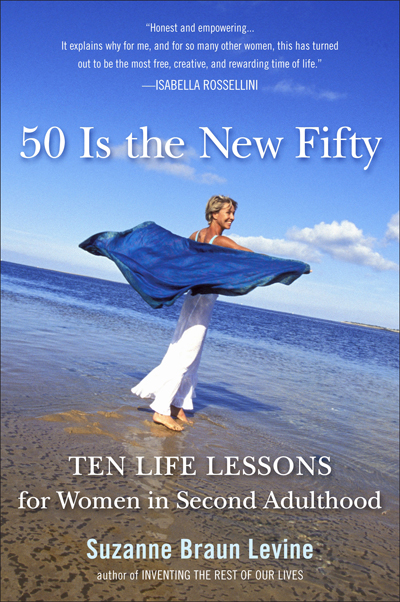
“FIFTY IS THE NEW FIFTY” –
For Immediate Release from Plume Books
We are ALL at the height of our Power!
“Well the first thing I want to say about Fifty is the New Fifty, is that it’s not the whole title. The whole title is 50 is the New Fifty, 60 is the new Sixty and 70 is the New Seventy…and who cares about birthdays anyway. The best thing is that we are all at the height of our power, and we feel that this is the most exciting time.”
-Suzanne Braun Levine
“I was told being mostly a model and an actress that growing old was going to be very difficult for me, so I was bracing myself. Instead I found that with age what continued to grow was a certain lightness, and a certain pleasure and freedom, and it was wonderful to read Fifty is the New Fifty and see that a lot of women feel that.”
– Isabella Rossellini
“I love where I am, it’s so liberating, I love being 50. When there’s a crisis you just kind of breathe right through it. It feels really good.”
– Rep. Donna F. Edwards (D-MD)
“I want to say to everybody at More magazine and to women who are afraid to mention their age or talk about age, and to the celebrities who want to be on the cover, but don’t want to talk about their age: ’You guys are going there whether you like it or not!’”
– Lesley Jane Seymour
“I’m especially grateful to Suzanne for the overall title of Fifty is the New Fifty, because it’s like the Zen message of aging, ‘We are where we are.’ And, I’m also grateful to her for expanding her title – I’m 75. The good news is I can still do what I’ve always done. But, the bad news is I think I’m immortal which then causes me to plan very poorly.”
-Gloria Steinem
___________________________________________
From the moment she took her “first step” backward off a ninety-foot cliff in an Outward Bound Program, to fulfill a personal mission and reconnect with her inner Tomboy at fifty, Suzanne Braun Levine has invented her own second adulthood. Her declaration: “Fifty is the New Fifty it is not the new Thirty,” on the opening page of FIFTY IS THE NEW FIFTY: 10 Life Lessons for Women in Second Adulthood (Now Available in Paperback/ Plume/ April 2010) celebrates the confidence and camaraderie of women fifty, sixty and seventy who are happy where they are and would not want to turn the clock back.
FIFTY IS THE NEW FIFTY and her previous book Inventing The Rest of Our Lives have defined and inspired a generation of women. “Our bond is common experience and the honesty with which we share it,” says Levine.
As women become the largest sector of the work force and the major breadwinners in many households, their roles are changing and new role models are emerging. Women in Second Adulthood – 37 million strong and growing are becoming each other’s ‘horizontal role models’, taking charge of their life, work and relationships.
What is important about second adulthood, Levine has found is that “the range of things we learn about ourselves – our bodies, our brains, our relationships and our approach to the world – is as wide as it was when we were adolescents.” It is a stage filled with questioning what’s next, a quest for mastery and authenticity, and wondering ‘Who is this person saying NO’ with confidence and a new bravado. Levine describes this questioning period – the Fertile Void – with exuberance and candor.
FIFTY IS THE NEW FIFTY: 10 Life Lessons for Women in Second Adulthood reads like a conversation among women friends – a circle of trust – who are generous, brave, funny, wise, and engaged in claiming their empowerment. Whether, it is rolling with the punches of a crisis (recovering from a divorce or cancer), seeing risks as opportunities, saying ‘No’ (“No, I won’t make cupcakes!”), questioning the meaning of work or putting themselves at the top of their ‘To Do List,’ Levine has captured the details of women’s changing lives. And, she has transformed their lives and her own into life lessons grounded in the experiences of women on the front lines of this new stage.
The ‘lessons’ in the book are a distillation of interviews with individual women, callers to radio shows, and her many lecturer appearances for groups like the Transition Network and her own circle of trust. She compares the ‘truths’ of this on-going conversation with women to those shared by mothers who find themselves on adjoining benches at a playground – tidbits of advice and commiserating about body changes, sleepless nights, and ultimately leading up to a rousing tide of knowing laughter. Recognizing the importance of friendship is part of a recalibration of ‘What Matters Most’ to women in second adulthood. Whether it is dealing with the loss of a friend or sharing the simple companionship of like-minded women which Levine says, “gives us courage, reduces stress, and is the best problem-solving environment there is, and the laughter women generate together is the elixir of life.”
“My hope is this book is like a welcome message in a bottle for women sent to them by a circle of trust, a circle that continues to grow and evolve,” says Levine. “We all have a lot more to share and I will be along on the journey to chronicle our every step.”
About Suzanne Braun Levine
Suzanne Braun Levine is a writer, editor and nationally recognized authority on women and family issues, and media. She’s chronicled and fostered change in women’s lives as the first editor of Ms. magazine and today as a contributing editor of More magazine. She is a lecturer, appears frequently on television, and is an advisor to several women’s and media groups, and organizations dealing with midlife issues. She defined a new stage of life – Women in Second Adulthood – and reports on the ongoing changes in women’s lives in her books and on her website.
Questions for Suzanne Braun Levine
What is the ‘Good News’ about being Fifty, Sixty, Seventy?
Women in Second Adulthood don’t want to be younger. They don’t buy into, “Fifty is the New Thirty!” and are happy where they are!
This is new stage is exhilarating. It is defined by change, the urge to bring new elements into the mix of our lives, to revise our established lifestyle, and most important, we feel empowered and confident that we can cope with whatever comes.
And, this is ‘Good News’ not only for my generation but also for younger women because they now have role models for what is possible after 50!
What is the ‘Bad News’ if there is any? What hasn’t changed enough?
Two things haven’t changed near enough. One is the burden of caregiving that falls upon women of all ages without any support from the society we live in. The other is ageism. It is very hard to convince yourself that you are as happy and fulfilled as you feel when the world around you is blowing you off. We have to make sure that we don’t make things worse by buying into the youth obsession.
Which of the 10 Lessons in the book was the hardest for you? The easiest?
The most difficult – and I think men will never understand how hard it is for women – was Lesson #4 – “No is not a Four-Letter Word.” Saying ‘No’ is extremely difficult for women. But now, I am constantly surprised how little trauma happens when I say No. I always thought the world would come to an end and everybody would hate me. I realized that most of the time it’s accepted as the natural order of things – you say, no, you say, yes – sometimes they come after you, but the nice thing about being this age is you feel like you can take it.
I don’t know about easiest, but the corollary to Saying No is “Do Unto Yourself as You Have Been Doing Unto Others” Lesson #6. Women are taught to be selfless, but once you start to say ‘No’ you find out what you need and want to do.
How do you gather the life stories that you use throughout the book?
Writing books about my life and women in second adulthood gives me an excuse to butt in to people’s lives. I eavesdrop on conversations; I ask impertinent questions of women I meet; I ask very personal questions of my friends. And I use my network and the Internet to find women with experiences to share. I am amazed and touched by how forthright, funny, and smart we all are.
How has your life changed since you began writing about women in Second Adulthood?
In figuring out what is going on for our generation of women, I have figured out a lot about the confusion, fear, and expectations that hit me as I entered this new stage of life – the part I call the ‘Fertile Void.’ It has also been exhilarating gaining insight into my life from hundreds of other women, dozens of experts, and some of the smartest writers and researchers.
And, by writing about it I have found my own voice for the first time in my life. I had always been an editor and so at first it was difficult for me put my [own story into my writing], but my editor convinced me. The more I realized that I had things to say, the more I was anxious to say them, and the prouder I was of having said them. Putting my ideas and myself out there was, in fact, the biggest risk.
Are you writing another book on Second Adulthood? What will you be exploring next?
My next book is about – get ready for this – LOVE! The more I learn about how we are getting to know ourselves and how we are redefining women’s experience, the more I am aware of changes we are making in the way we love, whom we love, and how we define intimacy, devotion, passion, and commitment. I am encountering wonderful stories that I am sure will surprise and delight women – those who have read my other books and those who are beginning to question the changes they are experiencing.
For Interviews, please contact:
Buy the book from PenguinGroup.com
FIFTY IS THE NEW FIFTY:
Ten Life Lessons for Women in Second Adulthood
By Suzanne Braun Levine
Author of Inventing the Rest of Our Lives